So, I had a short story accepted into an anthology…but I’ve rejected the acceptance.
I submitted a much-rejected short story to an anthology call with a theme that I thought it fit well. Imagine how hyped I was when apparently the publisher agreed, and sent me an acceptance email with a contract attached. Finally, a home for this bittersweet vampire tale!
Except, when I read the contract, I noticed there was no anti-GenAI specific clause. This is a very reassuring thing I’ve been seeing a lot of small presses do recently, so the absence of one struck me as odd, especially as the open call specified ‘No AI stories’ in its bullet points.
My gut told me to check their store–admittedly, something I probably should have already done, but forgive me for taking ‘No AI’ at face value. God forbid a bitch have a little trust, a little faith in the world.
Anyway, what I find are book covers and backgrounds that, in my opinion, are VERY clearly AI generated. They have that blank, soulless quality about them, the uncanny feeling. Not to mention the unclear merging of random things into others that you might not notice at first, until you look closer and go ‘huh, why is that flower petal turning into the paper?’ or ‘What actually is that blue thing?’
So, I emailed them back and asked what their stance is. I’ve seen an odd amount of people agaisnt GenAI writing but not art, so I thought maybe that bizarre nonsense was happening, or perhaps they’d been duped by cover sellers.
Their response was wishy-washy to say the least. Essentially, it does seem like they’ve been mislead by cover artists and stock photo sites. They claim to try their best not to use AI but that ‘it’s getting hard to tell what contractors are using.’ It came across as very passive, not at all like the aggressive anti-GenAI pledges I’ve seen in other small presses put on their sites and in their contracts.
Basically, it gave me the ick.
I can forgive them (sort of) for being duped by an AI loser once, but these things are so clearly not by a real artist, that it actually boggles my mind.
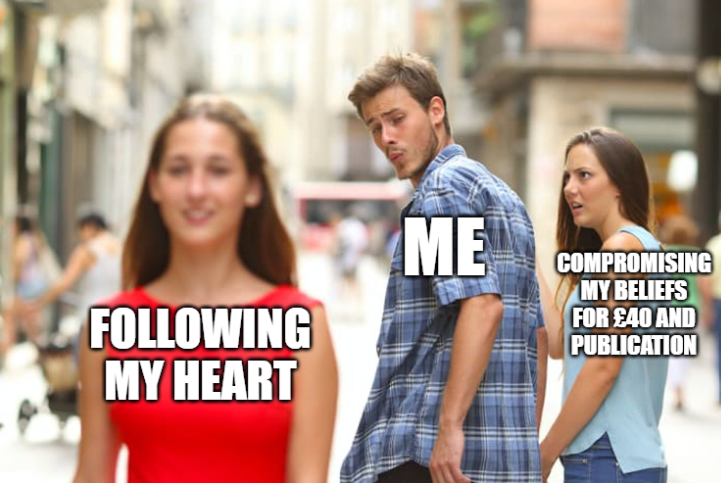
Which is why I’m turning down about £40 that I actually would really like to have, because my car is playing up again and fuck knows how much that is going to cost. (Just found out it’s £500! FML!) It’s a bit scary as a budding author to turn down an acceptance, but I really don’t want to risk my writing being associated with art theft, accidental or not. At the very least, I want a contract stating they won’t use it, so if they do, I can point at it and say “Hey, as far as I knew, they weren’t gonna! I’m innocent of this bullshit!”
I’m not going to name names, this post isn’t to shame anyone or call anyone out. They are a small publisher at the end of the day, and I am not an asshole. This is mostly a post to other new authors that, sucks as it might and scary as it is, sticking to your morals is the right thing to do. As I was talking this through with friends, asking advice for a question I already, deep down, knew the answer to, one of them pointed out I shouldn’t approach this with a scarcity mindset. This is not the last acceptance I’ll ever recieve. There will be more in the future. Turning down this one thing isn’t the end.
Damn, it does suck about the forty quid though.